
The blog title seems something crazy ?
Yes, by default your InnoDB transactions don’t have the Atomicity . But, you can control the atomicity of your InnoDB transaction with the variable innodb_rollback_on_timeout. We had a weird data inconsistency issue within the transaction . In this blog , I am going to explain “How it will happen?” and “How it can be fixed ?” .
Whats is Atomicity ?
From Wiki ,
Transactions are often composed of multiple statements. Atomicity guarantees that each transaction is treated as a single “unit”, which either succeeds completely, or fails completely: if any of the statements constituting a transaction fails to complete, the entire transaction fails and the database is left unchanged.
What is Innodb_rollback_on_timeout ?
From MySQL documentation,
InnoDB rolls back only the last statement on a transaction timeout by default. If –innodb-rollback-on-timeout is specified, a transaction timeout causes InnoDB to abort and roll back the entire transaction.
Here the transaction timeout will be happen based on the “innodb_lock_wait_timeout” setting .
All good, now we can experiment how it is working practically .
Experiment 1 ( Innodb_rollback_on_timeout = OFF )
I have created two MySQL client sessions ,
session 1 :

- innodb_rollback_on_timeout=OFF
- innodb_wait_timeout=50
- Started a transaction
- Ran the UPDATE to set name=’christ’ where id=1 ( not COMMIT )
now I am going to lock the second row ( id=2 ) at different session ( session 2 )
session 2 :
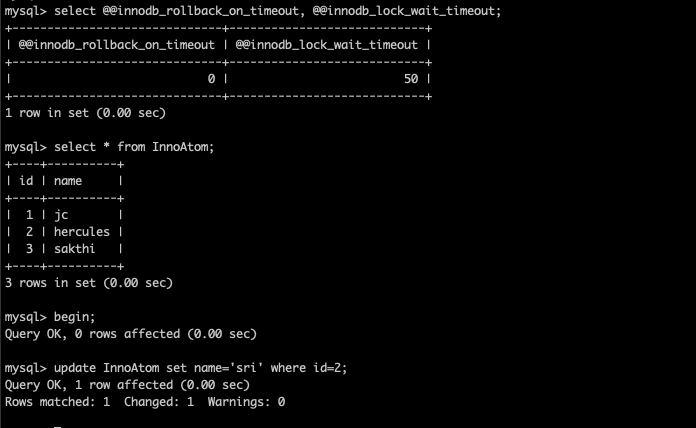
- Started the transaction at session 2
- Ran the UPDATE to set name=’sri’ where id=2 ( not COMMIT )
Now, I am going to update the same id = 2 at session 1 , so that it will exceed the innodb_lock_wait_timeout and the statement will fail .
session 1 :
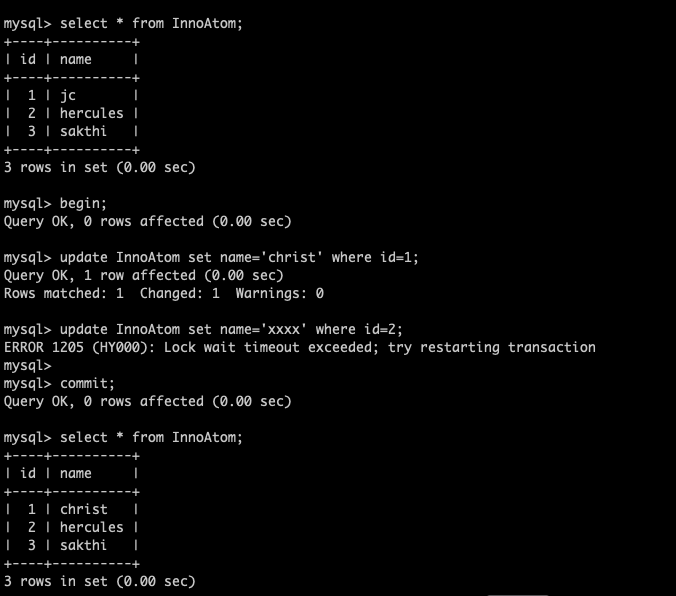
- Trying to access the row ( id=2 ) through the UPDATE
- The UPDATE was failed with lock wait timeout because the session 2 is already hold that row .
- Triggered the COMMIT
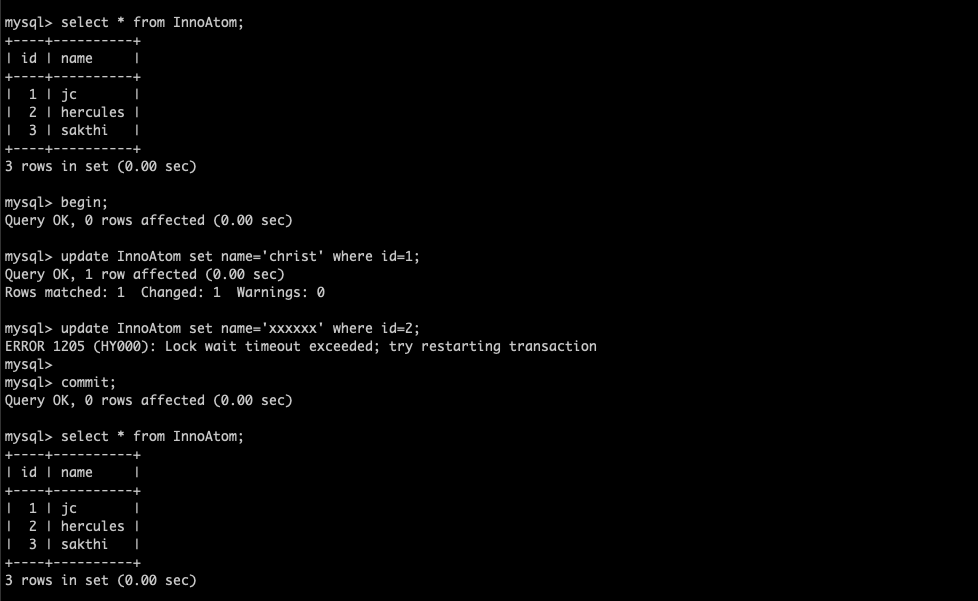
But after commit the transaction,
My first UPDATE was committed even the second statement was failed . You can see the output from the screenshot .
Sounds like ATOMICITY is missing ?
Lets do the second experiment …
Experiment 2 ( Innodb_rollback_on_timeout = ON ) :
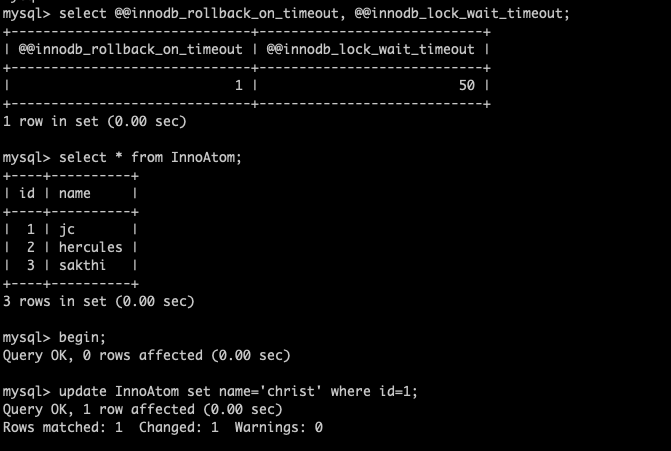
I am going to repeat the same procedure with innodb_rollback_on_timeout=ON,
session 1 :
started the transaction and updated the row id=1
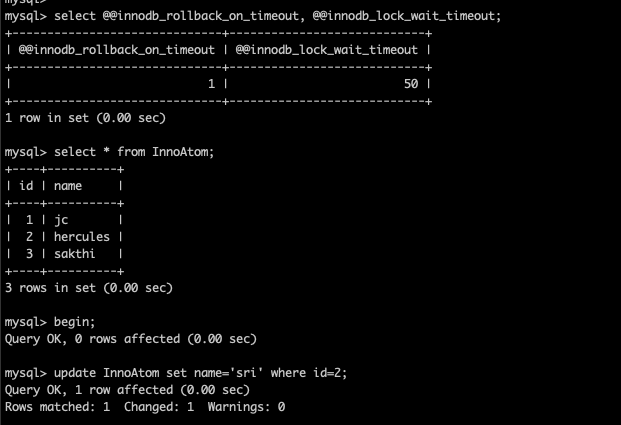
session 2 :
locking the row id=2
session 1 :
Creating the lock wait timeout inside the transaction and committing the transaction .
No changes happened . Make sense ?
With innodb_rollback_on_timeout = ON , Both the statements were not committed and the complete transaction has rolled back . THE ENTIRE TRANSACTION HAS ROLLBACK . So, this is the exact Atomicity right ?
Note : Changing the innodb_rollback_on_timeout requires the MySQL restart .
Hope this blog helps to understand the variable innodb_rollback_on_timeout . The blog proves, Having the innodb_rollback_on_timeout = ON provides the perfect/complete atomicity on your InnoDB system .
Thanks !!!
 Sakthi's MySQL Blog
Your application should retry the update or roll back. InnoDB is not losing atomicity. You commit a transaction with changes and that os just a bug in your app. Note that InnoDB always rolls back whole transactions on deadlock. Your application has to handle failed statements.
LikeLiked by 1 person
Hi Justin,
Thanks for your comment . Our applications has the proper error handling mechanism to handle the failures .
I had the issue, when I tested the variable innodb_rollback_on_timeout with different threshold ( ON and OFF ). The complete flow was documented in this blog . And, there is no deadlock happens , it is a LOCK WAIT TIMEOUT .
Even the document says “InnoDB rolls back only the last statement on a transaction timeout by default.”
LikeLike
Justin’s point is that you chose to explicitly commit the transaction after the failure. You had the choice to to repeat the statement or roll back to maintain atomicity.
LikeLiked by 1 person
Thanks Oystein Grovlen for your comment .
Yes Sir, I understand and completely agree with your point .
LikeLike
I agree with Justin Swanhart. InnoDB is not losing atomicity, when LOCK WAIT TIMEOUT rollback or commit depends on the application. application should handler the exception
LikeLiked by 1 person